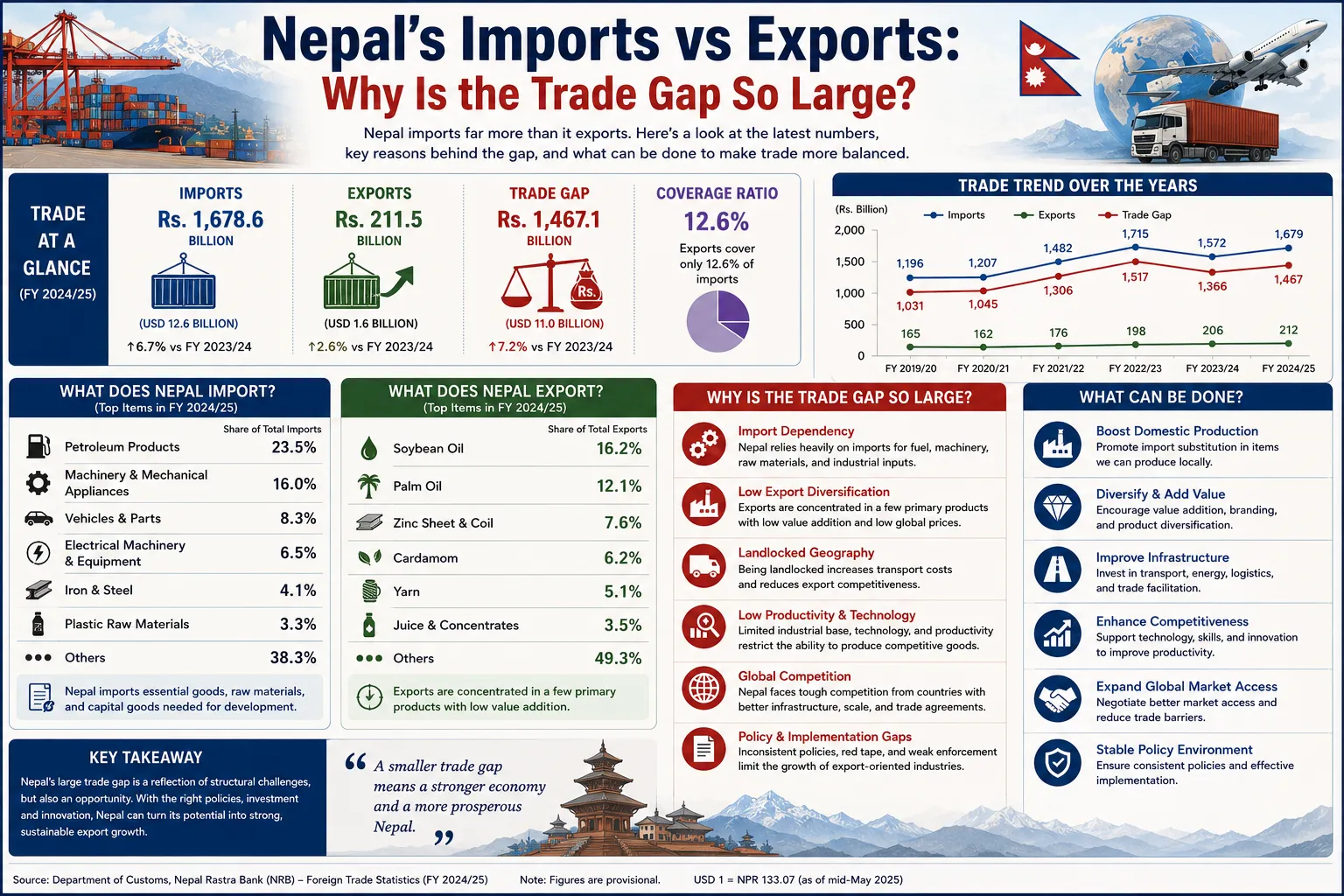
Nepal’s Imports vs Exports: Why Is the Trade Gap So Large?
Nepal’s foreign trade has reached a new high, but the country continues to face a familiar structural problem: it imports far more goods than it exports.
The latest full-year data for fiscal year 2025/26 (FY 2082/83) shows that Nepal imported goods worth approximately Rs 2.10 trillion, while merchandise exports stood at around Rs 315.3 billion. That left the country with a merchandise trade deficit of roughly Rs 1.78 trillion.
The figures underline a longstanding weakness in Nepal’s economy. The country is increasingly integrated into international markets, but its export sector remains too small and concentrated to match the value of goods entering the country.
Yet the trade deficit is more complicated than simply saying Nepal imports too much. Fuel, machinery, industrial raw materials, vehicles, medicines and other essential products make up a significant part of the import bill. At the same time, Nepal’s domestic industries face challenges related to productivity, infrastructure, logistics, investment and access to international markets.
Understanding that structure is essential to understanding why the trade gap remains so large.
Nepal’s Trade Deficit Has Reached a New Record
According to the latest Department of Customs data, Nepal’s total merchandise trade crossed Rs 2.4 trillion in FY 2025/26.
Imports rose to approximately Rs 2.096 trillion, up 16.2 percent from the previous fiscal year. Exports increased by 13.81 percent to around Rs 315.29 billion.
Because imports grew faster than exports, the trade deficit expanded to approximately Rs 1.78 trillion, compared with about Rs 1.53 trillion in FY 2024/25.
The numbers show an important distinction: Nepal’s exports are growing, but they are growing from a much smaller base.
For every Rs 1 worth of goods Nepal exported in FY 2025/26, it imported roughly Rs 6.65 worth of goods.
That imbalance is the central feature of Nepal’s merchandise trade.
What Does Nepal Import?
Nepal’s import bill is not dominated by a single category. It includes energy, industrial inputs, machinery, transportation equipment, electronics, food products and consumer goods.
Petroleum products are among the country’s largest imports. During FY 2025/26, diesel imports alone were worth more than Rs 170 billion, while petrol and liquefied petroleum gas (LPG) also accounted for substantial amounts.
This dependence is understandable. Nepal’s transportation system remains heavily dependent on petroleum, while LPG is widely used by households and businesses for cooking.
Other major imports include:
- Iron and steel products
- Vehicles and spare parts
- Machinery and industrial equipment
- Smartphones and electronic products
- Pharmaceutical products
- Chemicals and industrial raw materials
- Food and agricultural products
- Petroleum products
This is an important point when discussing the trade deficit. Not every import represents excessive consumption.
A factory importing machinery may be increasing its future production capacity. A business importing industrial equipment may eventually create jobs and substitute some future imports. Fuel imports, meanwhile, support transportation, construction, agriculture and other economic activity.
The real challenge is that Nepal has not yet developed enough domestic production and exports to offset the scale of these imports.
Nepal’s Export Sector Remains Relatively Small
Nepal’s exports crossed the Rs 300 billion mark for the first time in FY 2025/26, which is a positive development.
However, the export basket remains relatively narrow.
Refined soybean oil was the largest export item, with exports worth more than Rs 120 billion. Other important exports included large cardamom, carpets, jute products, refined sunflower oil and other agricultural or processed products.
The strong performance of edible oil exports illustrates both the opportunity and the weakness of Nepal’s export sector.
Processing and exporting agricultural products can create jobs and generate foreign currency. But some of these industries also depend on imported raw materials or intermediate products. As a result, gross export earnings do not always represent the same amount of domestic value creation.
Nepal therefore needs not only higher exports but also higher domestic value addition.
Why Doesn’t Nepal Produce More Domestically?
One of the fundamental reasons for the trade deficit is Nepal’s limited industrial and productive capacity.
Manufacturing businesses face several structural constraints. Nepal is a relatively small market situated between India and China, two of the world’s major manufacturing economies. Nepali producers therefore compete with companies that often benefit from much larger production scales and more developed supply chains.
Production costs can also be affected by transportation, financing, technology, labour skills, imported raw materials and regulatory complexity. For many products, importing from a large neighbouring market can be cheaper than manufacturing the same product in Nepal.
This creates a difficult cycle.
When domestic production remains limited, consumers depend on imports. When industries depend on imported machinery and raw materials, increasing production itself can increase imports. And when domestic companies cannot achieve competitive prices, exports remain limited.
Breaking this cycle requires productivity improvements rather than simply restricting imports.
Geography Makes Exporting More Difficult
Nepal’s geography is another major factor.

As a landlocked country, Nepal does not have direct access to a seaport. International goods must therefore move through neighbouring countries and transit routes.
Transportation costs, customs procedures and border infrastructure can significantly affect the final price of Nepali products.
This matters particularly for low-value or bulky goods. A Nepali producer may be able to manufacture a product competitively inside Nepal but struggle to compete internationally once transportation and logistics costs are added.
Improving highways, border infrastructure, dry ports, customs systems, warehousing and logistics services could therefore make Nepali exports more competitive.
India Dominates Nepal’s Trade Relationship
India remains Nepal’s largest trading partner by a considerable margin.
The two countries share a long border and have extensive economic links. A large proportion of Nepal’s imports come from India, while India is also the principal destination for many Nepali exports.
This proximity has clear advantages. Goods can move overland without the costs associated with distant markets.
However, it also means Nepal is heavily exposed to changes in the Indian market, Indian trade policies and regional supply chains.
China is another important trading partner, particularly for imports. Nepal imports a wide range of electronics, machinery, clothing, consumer products and other goods from China.
The imbalance between imports and exports is therefore not simply a problem with one trading partner. It reflects Nepal’s overall production and export structure.
Remittances Help Finance the Trade Deficit
There is another reason Nepal can sustain such a large merchandise trade deficit: remittances.
Millions of Nepalis work abroad, and the money they send home provides a major source of foreign currency.
According to Nepal Rastra Bank, remittance inflows during the first 11 months of FY 2025/26 reached approximately Rs 2.12 trillion, representing strong year-on-year growth.
Foreign-exchange reserves also remained comfortable, allowing Nepal to finance imports without facing an immediate external financing crisis.
This creates an important distinction.
Nepal can have a huge merchandise trade deficit while maintaining a relatively strong external position because remittances and other foreign-currency earnings help finance the import bill.
But this does not eliminate the structural problem.
Remittances are largely income earned by Nepali workers abroad. They provide enormous support to households and the national economy, but they do not by themselves create a large domestic export industry.
Does a Large Trade Deficit Mean Nepal Is in Trouble?
Not necessarily.
A trade deficit is not automatically harmful. Countries can run trade deficits while investing heavily in productive capacity.
The key question is what the imports are being used for.
If imports consist largely of machinery, technology, industrial equipment and productive inputs, they can support future economic growth.
The problem becomes more concerning when import growth is driven primarily by consumption while domestic productive capacity and exports remain weak.
Nepal therefore should not aim to eliminate imports altogether.
Instead, the goal should be to increase domestic production, improve productivity and develop exports that generate substantially more value inside the country.
Agriculture Could Help Reduce Import Dependence
Agriculture is one area where Nepal has significant potential.
Nepal imports substantial quantities of agricultural and food products despite having a large rural population and considerable agricultural land.
Improving irrigation, storage, agricultural technology, seeds, supply chains, processing facilities and market access could help increase domestic production.
However, simply producing more agricultural goods is not enough. Nepal needs commercially viable value chains.
For example, producing raw agricultural products and exporting them at low prices provides less economic value than processing, packaging and branding them for higher-value markets.
Products such as tea, coffee, cardamom, ginger, herbs and other speciality agricultural goods could benefit from stronger branding, quality certification and market development.

Manufacturing and Services Matter Too
Reducing the trade deficit will also require stronger manufacturing.
Nepal does not need to manufacture every product it currently imports. That would be economically unrealistic.
Instead, the country should focus on areas where it can develop genuine competitive advantages.
Potential areas include processed agricultural products, carpets and textiles, specialised handicrafts, pharmaceuticals, information technology and other knowledge-based services.
Services are particularly important because merchandise trade statistics do not capture the full value of Nepal’s service exports.
Tourism, IT services, education and other internationally traded services can generate foreign currency without requiring Nepal to physically export large quantities of goods.
A broader export strategy should therefore look beyond traditional merchandise exports.
Why Import Restrictions Alone Will Not Solve the Problem
Nepal has periodically used higher duties, restrictions and other measures to control imports.
Such policies can reduce demand temporarily, but they cannot solve the fundamental problem if domestic alternatives are unavailable.
If a country restricts an imported product without developing competitive domestic production, consumers may simply face higher prices.
Import management can therefore be useful in specific circumstances, but it should not substitute for industrial policy, infrastructure development and productivity improvements.
The long-term solution is to make domestic production more competitive.
What Nepal Needs to Do Next
A sustainable reduction in the trade deficit would require several changes at the same time.
First, increase productivity. Nepali businesses need better technology, skills, financing and infrastructure.
Second, reduce logistics costs. Roads, border points, dry ports, customs systems and warehousing directly affect export competitiveness.
Third, diversify exports. Depending heavily on a small number of products makes export earnings vulnerable to international prices and policy changes.
Fourth, increase domestic value addition. Processing agricultural and industrial products inside Nepal can create more economic value than simply exporting raw materials.
Fifth, reduce unnecessary import dependence. Where Nepal can produce goods competitively, domestic production should be encouraged through productivity rather than permanent protection.
Finally, expand service exports. IT, tourism and other internationally traded services can provide an important source of foreign currency alongside merchandise exports.
The Trade Gap Reflects Nepal’s Economic Structure
Nepal’s Rs 1.78 trillion merchandise trade deficit in FY 2025/26 is not simply the result of consumers buying too many foreign products.
It reflects a deeper imbalance between what Nepal demands from the international economy and what its domestic economy is capable of producing competitively.
Imports are essential to Nepal’s economy. Fuel, machinery, raw materials, technology and other imported goods support households and businesses. The problem is that exports remain too small and insufficiently diversified to balance that demand.
Remittances currently provide a powerful source of foreign currency, helping Nepal finance its large import bill. But relying indefinitely on income earned by workers abroad is not the same as building a productive domestic economy.
The long-term objective should therefore not be to make Nepal import less at any cost. It should be to make Nepal produce more, produce competitively and export products and services with greater domestic value.
That is the more sustainable way to narrow the trade gap.
References
- Nepal Rastra Bank — Official Website
- Nepal Rastra Bank — Current Macroeconomic and Financial Situation
- Nepal Rastra Bank — Macroeconomic Reports
- Department of Customs — Government of Nepal
- Trade and Export Promotion Centre — Government of Nepal
- Kantipur — Nepal’s Foreign Trade Data
- Sharesansar — Nepal’s Macroeconomic Data
For more: Economics