Nepal’s Population Is Changing: What the Latest Data Tells Us (2026)
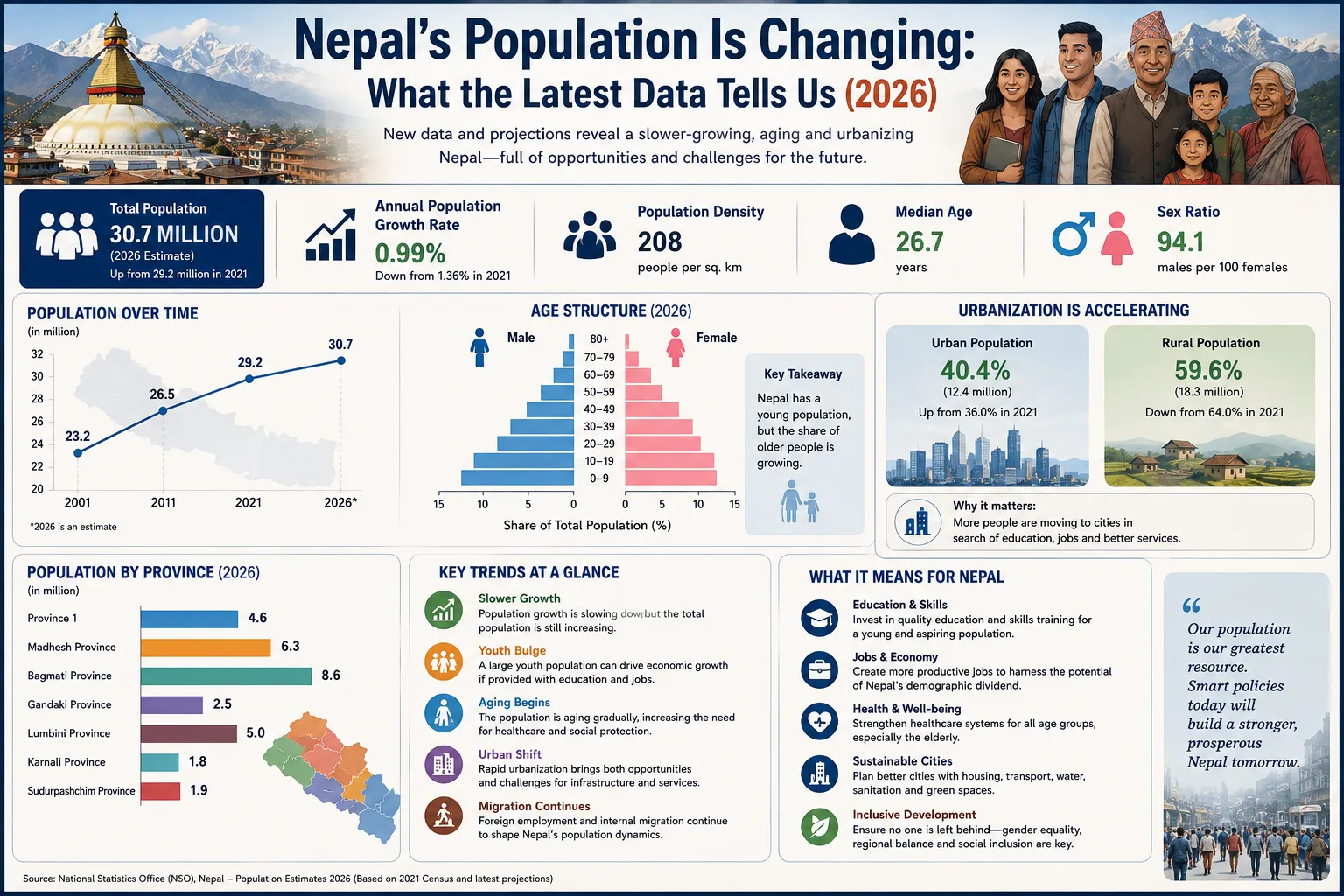
Nepal’s population story is no longer simply about growth. The country is entering a more complex demographic phase marked by slower population increase, falling fertility, large-scale migration and a growing concentration of people in urban areas.
The latest comprehensive picture comes from the National Population and Housing Census 2021, conducted by the National Statistics Office (NSO). It counted 29,164,578 people in Nepal—an increase of roughly 2.67 million from 2011. But the annual average population growth rate had fallen sharply to 0.92 percent, compared with 1.35 percent in the previous decade.
That change matters. It affects schools, jobs, housing, healthcare, local government, infrastructure and the country’s long-term economic prospects.

Nepal Is Still Growing, but Much More Slowly
The most striking feature of Nepal’s demographic transition is the slowdown in population growth.
Between 2001 and 2011, Nepal’s population grew at an average annual rate of 1.35 percent. By 2021, that had dropped to 0.92 percent. The census also recorded a population density of 198 people per square kilometre.
This does not mean Nepal’s population has stopped increasing. Rather, the pace of increase has weakened considerably.
The National Statistics Office’s population projections point towards further slowing in the coming decades. The projections use different demographic scenarios, but declining fertility and continued migration are central features of Nepal’s changing population structure.
For policymakers, this is a very different challenge from managing rapid population growth. Future planning will increasingly have to consider ageing, labour shortages in some sectors and the changing size of younger generations.
Fewer Children Are Being Born
Fertility is one of the clearest explanations for Nepal’s slower population growth.
The 2021 census thematic report records a dramatic fall in Nepal’s total fertility rate, from 5.74 children per woman in 1961 to 1.94 in 2021. The decline is associated with factors including higher education, greater access to family planning, urbanisation and broader socioeconomic changes.
But the national average hides significant differences.
Fertility is lower in places such as Bagmati and Gandaki and higher in Madhesh and Karnali. The census also found lower fertility-related indicators in fully urban areas than in rural and peri-urban areas.

For ordinary households, this demographic shift can already be seen in changing family sizes. Families with one or two children are increasingly common, while the very large households that were more typical several generations ago are becoming less prevalent.
The long-term effect is significant: fewer children entering the population today means fewer young adults entering the labour force two decades from now.
Migration Is Reshaping Where Nepalis Live
Population change in Nepal cannot be understood without migration.
The 2021 census recorded more than 8.2 million recent internal migrants, representing a recent internal migration rate of 29.2 percent among the relevant native-born population. Migration was substantially higher in urban municipalities than in rural municipalities. Kathmandu Valley recorded the highest recent migration rate among the geographic areas examined.
This helps explain why some rural communities are losing population while cities and emerging urban centres continue to expand.
Migration is not simply a movement from villages to Kathmandu. People move between municipalities and provinces for employment, education, marriage, family reasons and other opportunities. The census found that rural-to-urban movement was an important component of internal migration.
International migration adds another layer.
The 2021 census counted 2,190,592 people absent from their households and living abroad, including about 1.80 million males and 391,000 females. (https://censusresults.nsonepal.gov.np/)
That figure is more than a migration statistic. It has consequences for household composition, local economies and the availability of working-age people in communities across Nepal.
The Population Is Becoming More Urban
According to the 2021 census, 19.3 million people—about 66 percent of Nepal’s population—were living in areas classified as urban municipalities, while 9.87 million lived in rural municipalities.
However, these figures need to be interpreted carefully. Nepal’s administrative classification of municipalities does not always correspond neatly to how urban a place actually is. A municipality may contain extensive agricultural or rural settlements.
Even so, the broader trend is unmistakable: population and economic activity are becoming increasingly concentrated around urban and peri-urban areas.
Kathmandu Valley remains the country’s strongest population magnet, but Pokhara, Bharatpur, Butwal and other growing urban centres are also attracting residents.
This creates both opportunities and pressures. Cities need reliable roads, public transport, water supply, waste management, housing, healthcare and employment. If population growth in urban areas is not matched by infrastructure and planning, congestion and housing costs can rise while public services come under pressure.
Nepal Still Has a Large Working-Age Population
There is also a positive side to Nepal’s demographic transition.
The 2021 census found that about 65.2 percent of the population was aged 15–64, while the dependency ratio had fallen to about 53.3 dependents per 100 working-age people. This creates what economists call a potential demographic dividend: a period when a relatively large working-age population can support faster economic growth.
But having a large working-age population does not automatically create prosperity.
Nepal needs productive employment, skills, investment and businesses capable of absorbing workers. If young people cannot find sufficient opportunities at home, international migration will remain an attractive option.

The demographic dividend is therefore a window, not a guarantee. The country’s ability to turn its population structure into economic gains will depend heavily on education, vocational training, infrastructure and job creation. The NSO has specifically identified human-capital development and stronger employment opportunities as important to capturing this opportunity.
What the Numbers Mean for Nepal’s Future
Nepal’s changing population creates several policy priorities.
First, education systems will need to adapt. Falling fertility could eventually mean fewer children entering schools, while demand grows for better-quality education and technical skills.
Second, healthcare planning will have to prepare for ageing. As fertility declines and life expectancy improves, the proportion of older people will gradually become more important.
Third, urban planning will become increasingly important. Population movement towards cities requires better housing, transport, water, sanitation and employment planning.
Finally, Nepal needs to think seriously about migration and employment together. Overseas migration has become deeply embedded in the economy, but sustained dependence on labour migration also means that large numbers of economically active Nepalis are living outside the country.
A Smaller Growth Rate Does Not Mean a Smaller Challenge
Nepal is not facing a simple population decline story yet. The more important development is that the country’s demographic momentum is changing.
The 2021 census shows a nation with slower growth, much lower fertility, substantial internal migration, millions of citizens living abroad and a large working-age population.
For Nepal, the question is therefore shifting from “How do we manage a growing population?” to “How do we build an economy and public services suited to a changing population?”
That distinction will become increasingly important in the years ahead. The demographic data is already showing where the country is heading; the bigger challenge is whether planning and investment can keep pace with it.